Kimi K3.1 Pro
OpenAI & Anthropic drop-in replacement
Inference at thespeed of thought.
Serve frontier open-weight models through OpenAI-compatible endpoints. Quantization labels published externally for every one, and pricing set by a market rather than a margin.
OpenAI SDK compatible • Quantization published externally • Prompt caching included
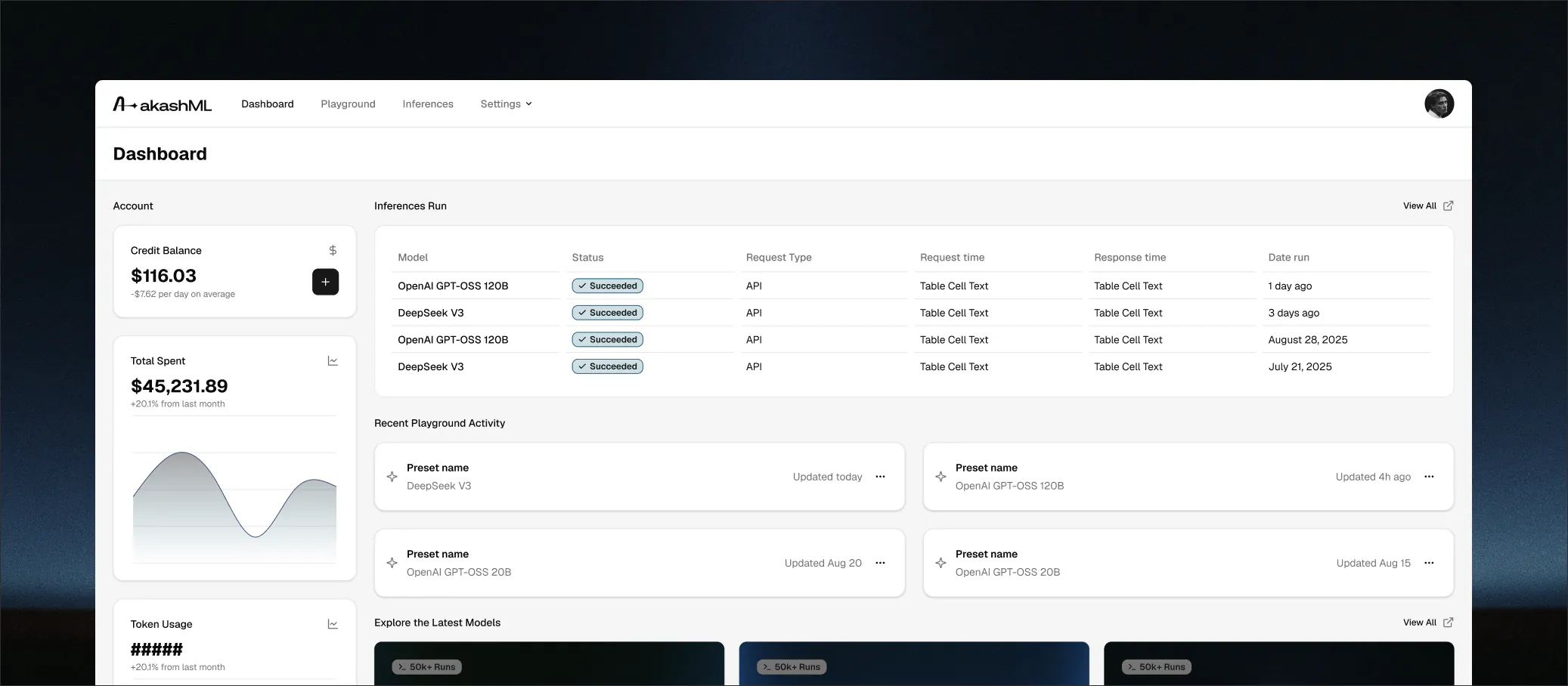
Start chatting with your prompt.
Describe what you need — then run it for real. Same OpenAI-compatible endpoint, frontier open models, up to 85% below first-party API prices.






What each model is for
Different work,
different models,
one price sheet.
Each model below is built for a different kind of work: agentic engineering, tool use, deep reasoning, multimodal code, everyday chat and more. Pick by fit, then check the price underneath.

Kimi K3.1 Pro
2.8T / 104B active · 1M context
Coding, 3D creation and long-horizon agent work.
Input / 1M$1.75
Output / 1M$10.00
Cache read / 1M$0.18

GLM 5.3
753B parameters · 1M context
Complex coding and long-horizon agent work.
Input / 1M$0.19
Output / 1M$4.40
Cache read / 1M$0.19

Qwen 3.8 27B
27B parameters · 262K context
Dense vision-language model for coding and research.
Input / 1M$0.225
Output / 1M$1.98
Cache read / 1M$0.05

Qwen 3.6 35B A3B
35B / 3B active · 262K context
Multimodal hybrid MoE for reasoning and code.
Input / 1M$0.10
Output / 1M$0.90
Cache read / 1M$0.05

GPT OSS 120B
120B / 5.1B active · 128K context
Open-weight MoE for reasoning and tool use.
Input / 1M$0.037
Output / 1M$0.187
Cache read / 1M$0.037

Llama 3.3 70B
70B parameters · 128K context
Instruct-tuned for general reasoning and chat.
Input / 1M$0.20
Output / 1M$0.52
Cache read / 1M$0.10
Don’t see the model you need?
Every model page takes integration requests. The library grows from what people are actually building on.

$0.05 / 1M
Per 1M cached input tokens on Qwen 3.8 27B — about 78% below fresh input.

1M token context
Full context on Kimi K3.1 Pro and GLM 5.3 — whole repos in one prompt.
Proof on independent compute
Razer Powers Viral AI
Inference on Akash
To scale its global AVA Mini campaign, Razer integrated its open-source AIKit platform with the Akash independent compute network. By pooling distributed high-performance consumer GPUs behind a single managed endpoint, the engineering team achieved reliable elastic scaling with zero manual infrastructure intervention.
Read Case Study$0.01
per generated image
3.24s
avg. end-to-end response time
3–15x
lower inference costs than centralized APIs
Pricing and precision
The price, and where to check it.
A rate means nothing until you know what’s behind it. Quietly narrowed weights cost output quality that never shows up on an invoice — which is why OpenRouter publishes a quantization label for every endpoint we run, independently of us.
| Model | Input / 1M | Output / 1M | Cache read / 1M | Context | Action |
|---|---|---|---|---|---|
| Kimi K3.1 Pro | $1.75 | $10.00 | $0.18 | 1M | Test |
| GLM 5.3 | $0.19 | $4.40 | $0.19 | 1M | Test |
| Qwen 3.8 27B | $0.225 | $1.98 | $0.05 | 262K | Test |
| Qwen 3.6 35B A3B | $0.10 | $0.90 | $0.05 | 262K | Test |
| GPT OSS 120B | $0.037 | $0.187 | $0.037 | 128K | Test |
| GPT OSS 20B | $0.018 | $0.09 | $0.009 | 128K | Test |
| Llama 3.3 70B | $0.20 | $0.52 | $0.10 | 128K | Test |
See the full pricing page
Per-model rates, the estimator, and how we compare against first-party APIs.
“The future of AI isn’t just better models – it’s efficient infrastructure. With Razer AIKit, many use cases already run locally. With Akash, we extend that into a decentralised cloud to scale efficiently.”
QUYEN QUACH
Vice President of Software, Razer
What you’re actually buying
Every other inference provider is a store. AkashML is a market.
A store sets its price from corporate margins and capital overhead. A market discovers what compute actually costs by letting hardware operators compete for your workload — and publishes the result somewhere you can check it without taking our word for it.

Multi-provider reverse auction
Providers compete for your workload
Capacity comes from independent operators bidding against each other for the job, so no single vendor sets the price.

Marketplace pricing
Priced by a market, not a margin
Rows carrying a time-limited rate are labelled with list struck through — when one ends you pay the list rate shown beside it, nothing more.

Independent verification
Published where we can’t edit it
Our prices, context limits and quantization labels sit on OpenRouter’s provider page, next to every other host of the same weights. The network’s own numbers come from Akash’s public dashboard API. Neither runs on our infrastructure.
Compare us on OpenRouter
Drop-in compatibility
Zero SDK rewrites
Keep your codebase, your Claude Code setup, your Cursor agents and your OpenAI SDK. Swap the base URL and you’re running at up to 85% below first-party API prices.

Direct developer channel
A shared channel, not a ticket form
Support runs in the community channel. Ask in the open and get an answer there — no portal, no case number, no form you can’t see the queue behind. Join the channel ↗
Scope and limits
What AkashML
is.isn’t.
Easier to read this now than to find out in week three. We’d rather be straight about the boundaries than win a build you migrate away from in a quarter.
What AkashML is.
Managed inference, per token
No GPU to provision and no capacity to reserve up front.
OpenAI-compatible
Change base_url and api_key. The rest of your code is untouched.
No lock-in
That same base URL points anywhere else. Open weights, standard endpoints, nothing proprietary to unpick.
Works with the tools you already use
Claude Code, Cursor, Cline, OpenHands, any standard SDK.
Prompt caching where supported
Cache reads run about 78% below fresh input — $0.05 against $0.225.
Quantization you can check
OpenRouter publishes a label for every endpoint we run, independently of us.
Direct developer support
Ask in the shared community channel instead of filing a ticket.
What AkashML isn’t.
Not a place for your own weights
We run a curated library, not your container.
Not SOC 2 or HIPAA certified yet
Need a signed certificate today? We aren't your host.
Not a padded catalogue
No dead models inflating a count. The library grows on request.
Not a free tier that scales
The playground is for evaluating. Production runs on a paid account.
Not SLA-backed today
Uptime is published on OpenRouter, so you can judge it before committing.
FAQs
If something here isn’t covered, the docs have the detail — or ask in the shared community channel and get an answer from someone who works on it.
What is AkashML?+
AkashML is managed inference for open-weight models, running on GPUs from the Akash Network marketplace. You call the models through an OpenAI-compatible API or an Anthropic-compatible Messages endpoint and pay per token.
Which models can I use?+
Every model we currently serve is listed in the model library, with its rates on the pricing page. The library is curated rather than exhaustive. If the model you need isn't there, request it; we review requests regularly when deciding what to add.
Do I need to change my code to use AkashML?+
Very little. If you use an OpenAI SDK, point its base URL at https://api.akashml.com/v1 and swap in your AkashML API key and a model id. Claude Code and other Anthropic clients use https://api.akashml.com/anthropic instead; see the Claude Code setup.
Where are datacenters located?+
Inference runs on GPUs supplied by independent providers on the Akash Network. The network's current providers and their regions are published on Akash's network stats.
Where can I find documentation?+
Full documentation, guides, and API references are available in our docs.
How is pricing calculated?+
Pricing is per 1M tokens, with separate rates for input and output, and a cache-read rate where the model supports prompt caching. Each model's rates are on the pricing page. You only pay for what you use, with no minimum commitment.
Are there free credits available?+
Yes. New accounts start on a free tier with free credit and no card needed. It covers selected models in the Playground, with per-request limits. Adding credits unlocks every model and API keys. If you need more to evaluate a larger workload, contact us.
Can I predict my monthly costs?+
Yes. Multiply your expected input, output and cache-read tokens by the model's published rates. The spend estimator on the pricing page does this for common workloads.
What payment methods are accepted?+
We accept card payments. Credits can be topped up manually or automatically when your balance runs low.
Start building.
Create a free account, copy your API key, and point your SDK at one new base URL. Nothing else in your code has to change.